

Types of Steel Springs
Available for Custom Machining
A Guide to Compression | Extension | Torsion | Flat Springs
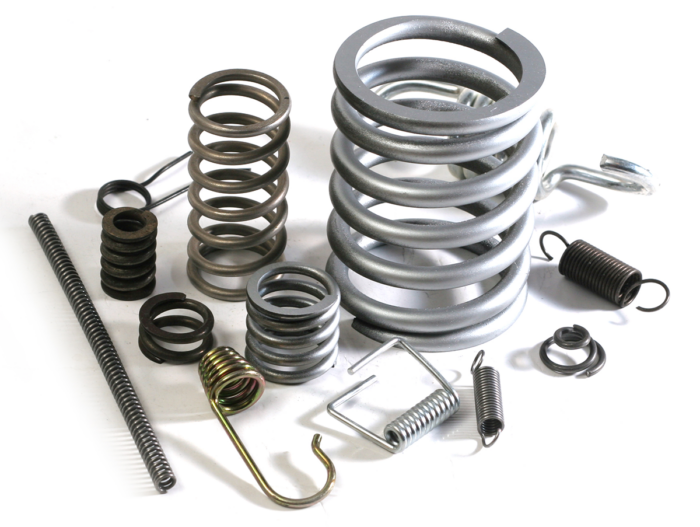
Custom Steel Springs are among the most versatile and widely used components in modern manufacturing. Found in everything from automotive assemblies and industrial equipment to consumer products and medical devices, springs provide controlled force, absorb shock, store energy, and maintain tension in countless applications. Understanding the different types of steel springs that are available can help engineers and buyers select the best solution for their specific requirements.
Understanding the Different Types of Steel Springs
Steel springs are manufactured in a variety of configurations, each designed to perform a unique mechanical function. The most common types include compression, extension, torsion, and flat springs.
Several Factors to Consider when Selecting Springs:
- Outside diameter of the spring
- Load requirements
- Pull or compression force
- Active coils
- Solid height
- Material types:
- High Carbon Hard Drawn: ASTM A227
- High Carbon Music Wire: AISI 1070 / ASTM A228
- High Carbon Oil Tempered: ASTM A229
- Alloy Steel Chrome Silicon: ASTM A401
- Alloy Steel Wire: AISI 6150
- Stainless Steel: 304 / 316 / 17-7 PH / ASTM A313
- Non-Ferrous: Monel 400
- High Temp: Inconel 600 / 718 / 750
- Brass
- Nickel Inconel®
- Finish
- Application requirements
Steel Materials Used for Spring Manufacturing
Spring performance depends heavily on material selection. Carbon steel, stainless steel, music wire, alloy steels, brass, and nickel are among the most common materials used in spring production. Each offers distinct advantages related to strength, corrosion resistance, temperature performance, and fatigue resistance. Selecting the proper material ensures the spring can withstand its operating environment while delivering consistent results throughout its lifespan. Check out our Custom Springs, Wire Forming, & Tube Bending page for more information on our capabilities and to see our extensive competences in design and production management of these custom parts.
Compression Springs
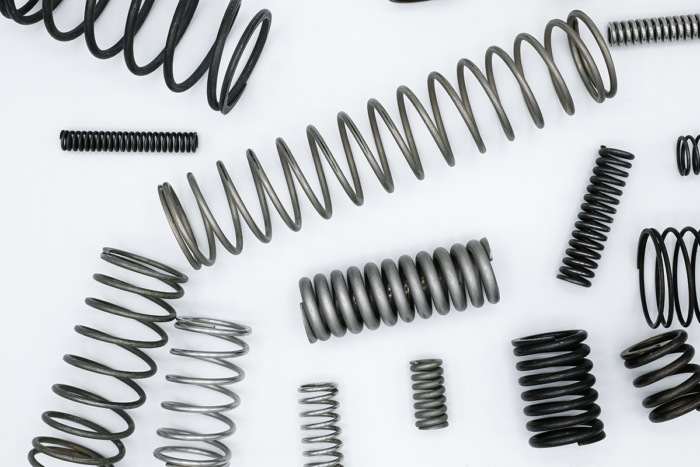
Compression Springs are helical coils designed to resist compressive forces. When pressure is applied, the spring shortens and stores energy. Once the load is removed, it expands back to its original length. Since no attachment points are required, compression springs are easy to integrate into a variety of assemblies. They are the most widely recognized type of spring and are designed to resist compressive forces. They are found in everything from consumer products to industrial equipment, where reliable force and long-term performance are essential.
Compression springs can be manufactured in numerous sizes, wire diameters, and materials to meet specific load and life cycle requirements. Factors such as spring rate, operating environment, and available installation space all influence the final design.

Diagram of a Compression Spring
- Compression spring end types
- Closed and Ground
- Closed and Not Ground
- Open and Ground Ends
- Open and Not Ground Ends
Extension Springs

Extension Springs are mechanical components used to create resistance to a pulling force between two opposing components. They are designed to absorb and store energy while resisting a pulling force. During the coiling process, the wire is twisted to create initial tension, which determines how tightly the spring coils together. This built-in tension can be adjusted to achieve specific load requirements. When the spring is pulled apart, it resists the force by releasing that stored tension.
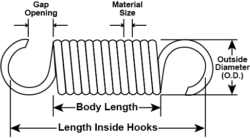
Diagram of an Extension Spring
Unlike compression springs, these springs are stretched during operation and contract when released. They typically feature loops, hooks, or specially designed ends for attachment. Extension springs are frequently used in consumer products, agricultural equipment, and industrial assemblies where tension forces must be controlled. Proper end design and material selection are critical to ensuring long service life and reliable performance.
Torsion Springs
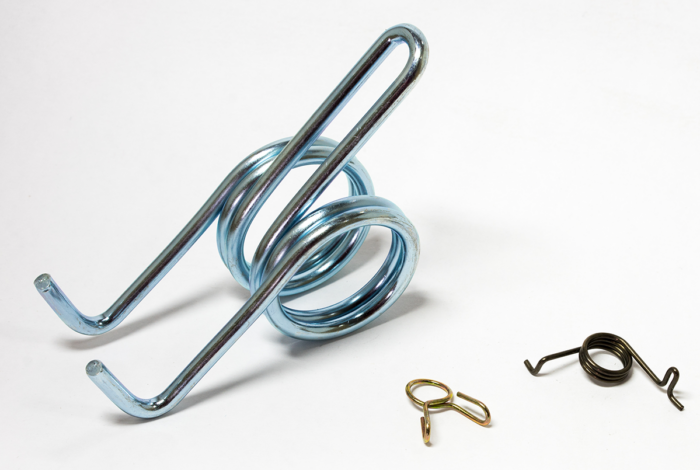
Torsion Springs work differently than compression and extension springs. They store energy by twisting around an axis rather than being compressed or stretched and then provide an angular return force. These springs generate torque and rotational force and are commonly used in hinges, clips, levers, and counterbalance mechanisms.
Because torsion springs are subjected to rotational loading, precise engineering is essential to achieve consistent performance and durability. Both single-body and double-body torsion spring configurations are available depending on application requirements. Torsion spring sizes range from miniature, for use in electronic devices, to large torsion springs, used in chair control units, as a few examples. Double torsion springs consist of one set of coils, coiled right hand and one set of coils coiled left hand. These coils are connected, usually with an unwound section between the winds and work in parallel. The sections are designed separately with the total torque being the sum of the two. They are particularly valuable where a balanced twist-free force is required in delicate mechanisms.
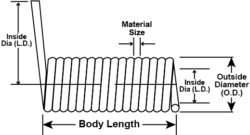
Diagram of a Torsion Spring
Flat Springs and Custom Spring Designs
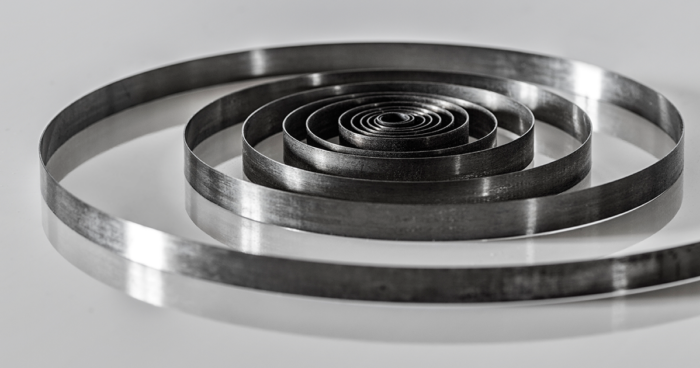
Custom Flat Springs are designed to store and release energy by elastic bending under load rather than the torsional action used by coil springs. Unlike coil springs, which work by twisting, flat springs generate force through controlled bending. Made from flat strips of spring steel, they are ideal for applications where space is limited or where the spring can also serve as part of a mounting or support assembly.
Their flat design allows for custom shapes, features, and mounting configurations, making them a versatile solution for a wide range of products and engineering applications. Custom spring solutions often address challenges such as limited space, unusual load conditions, or specialized performance requirements. Material thickness, geometry, and heat treatment processes can all be tailored to meet exact specifications. Industries that use Flat Springs include: automotive, electronic devices, medical, aerospace, and industrial.
Types of Flat Springs
- Cantilever Springs
- Simple Beam Springs
- Disc Springs
- Wave Springs
- Constant Force Springs
- Leaf Springs
Partner with Cardinal Components for Custom Spring Solutions
At Cardinal Components, Inc., we understand that no two applications are exactly alike. Our team works closely with customers to source and manufacture steel springs that meet demanding performance, quality, and budget requirements. Whether you need compression springs, extension springs, torsion springs, flat springs, or fully customized spring designs, we can help identify the right solution for your application. As an ISO 9001:2015 certified supplier, Cardinal Components is committed to providing dependable service, and responsive support throughout the sourcing process.
Contact Cardinal Components, Inc. today to discuss your spring requirements. Simply send your drawing and estimated annual usage (EAU) to [email protected], and we’ll provide a competitive quote along with expert guidance to help find the right spring solution for your application!